Yes, 2D Barcodes Will Change Retail - But There's a Lot of Inertia to Overcome First
Moving from a static 1D barcode to a dynamic 2D barcode is not a simple graphic design update. For fifty years, brands have printed millions of identical packages with a static EAN code stamped in the corner. To switch to a dynamic 2D barcode, a manufacturer has to print a unique, high-resolution QR code on every single package in real time on a fast-moving production line.
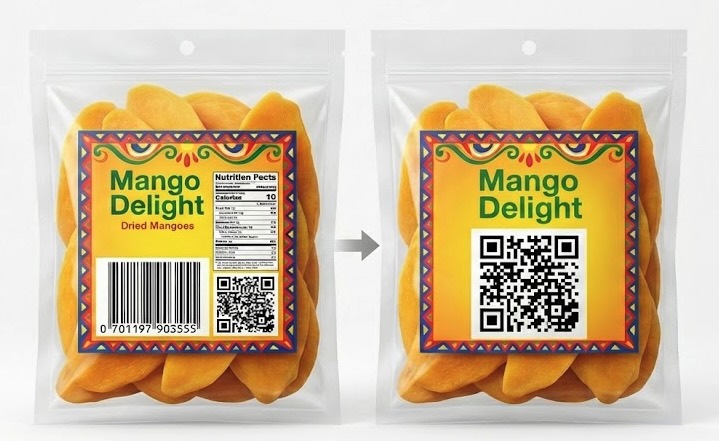
We are officially halfway through 2026. That means there are only six months left until "Sunrise 2027," the globally hyped GS1 milestone meant to revolutionize the retail supply chain. This initiative promises to phase out the humble, 50-year-old linear UPC/EAN barcode in favour of data-rich 2D barcodes, such as QR codes.
If you listen to the industry press, you would think we are on the precipice of a retail utopia. They promise checkouts that instantly block expired food, hyper-efficient stock management, and consumers gleefully scanning packages to read sustainability logs.
Yet, if you walk into almost any grocery store today, the silence of the 2D revolution is deafening.
A few weeks ago, the industry finally got something concrete to celebrate. Tesco announced with great fanfare that it is transitioning its entire core own-label sausage range to GS1-powered QR codes. Working with supplier Cranswick, 13 lines of pork sausages, chipolatas, and sausage meat are shedding their linear barcodes entirely.
The benefits are genuinely impressive. At the point of sale, these new codes don't just identify a pack of bangers; they carry real-time use-by dates and batch data. As reported by Retail Systems, if a batch faces a product recall, the checkout can block that specific batch at the till instead of forcing staff to dump the entire inventory. For the consumer, Packaging Europe noted that scanning the pack reveals ingredients, recycling advice, and a clear digital layout that is much easier to read than crinkled plastic.
It is a fantastic case study. But let’s look closer: it is one product range, from one supermarket chain, in one country.
Where is everyone else? If 2D barcodes are supposed to be the standard in six months, why is the biggest news in global retail literally just sausages?
The reality is that retail is trapped in a classic standoff of cautious inertia.
On the retail side, upgrading point-of-sale systems is a massive headache. While many modern optical scanners are technically capable of reading a 2D barcode, upgrading the backend enterprise resource planning (ERP) systems to actually process dynamic batch data, serial numbers, and expiration dates is a complex, costly IT project. No store wants to activate a system that might accidentally freeze up checkouts during the Saturday morning rush.
But the real, unvarnished bottleneck is sitting on the manufacturing floor.
Moving from a static 1D barcode to a dynamic 2D barcode is not a simple graphic design update. For fifty years, brands have printed millions of identical packages with a static EAN code stamped in the corner. If they needed to print a batch number or a best-before date, they used cheap, low-resolution inline inkjet coders to stamp text onto the packaging at the very last second.
To switch to a 2D barcode, a manufacturer has to print a unique, high-resolution QR code on every single package in real time on a fast-moving production line. If the ink smudges, the code becomes unreadable, the product gets rejected by the retailer, and profits evaporate. Upgrading these production lines requires massive capital expenditure on high-precision laser or thermal inkjet printers, integrated vision inspection systems, and software that can feed unique data to the printer at a rate of hundreds of items per minute.
For a mid-sized brand, that is a terrifying financial hurdle for a technology that retailers aren't even forcing them to use yet.
This hesitation is exactly what we are seeing on the ground. A voluntary shift driven by standard bodies simply lacks the teeth required to move the needle.
"We have been offering free 2D barcode image generation for over a year now, and the uptake is still remarkably slow," says Anthony Blears, director of Barcodes Philippines. "Product owners look at the technology, see the long-term benefits, and then look at the cost of changing their production lines and decide to wait. A simple GS1-led standards push is just not sufficient. It is going to take hard mandates from major retailers refusing to stock products without 2D barcodes to actually convince brand owners to incorporate this technology."
Right now, brands have no incentive to be the first to blink. Why spend thousands upgrading a factory line when a traditional barcode still beeps perfectly fine at all of the world's checkouts?
Sunrise 2027 was intended to be a glorious morning for retail efficiency. But unless supermarkets stop dipping their toes in the water with a few isolated sausage trials and start throwing down rigid deadlines, that sunrise is going to look a lot like a long, drawn-out twilight.